

















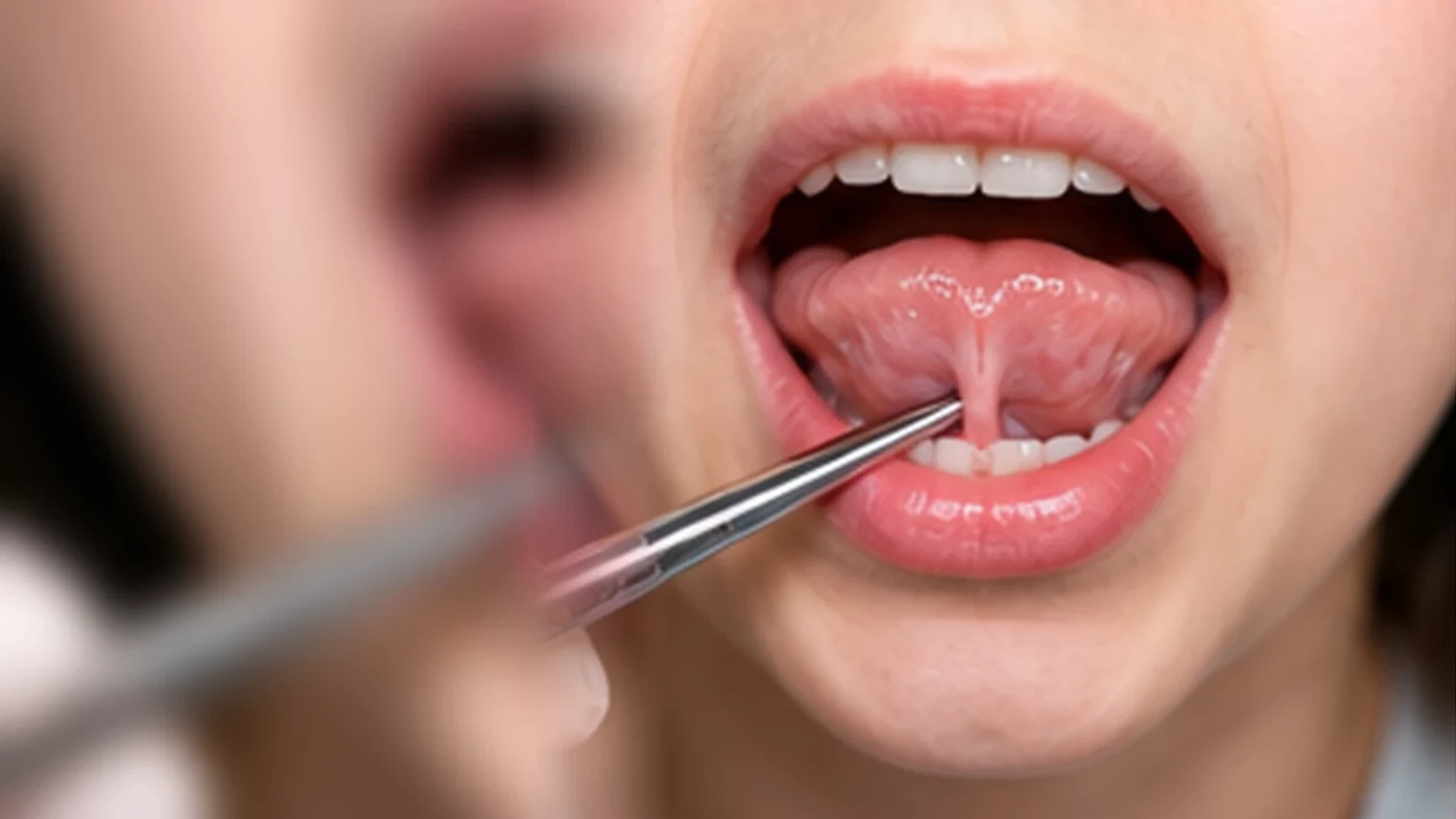

Is every “tongue-tie” treated?
No. A visible frenum is normal anatomy. Treatment is considered when restriction is linked to a meaningful functional problem and release is expected to help.

What problems can a restrictive frenum cause?
Depending on age and severity, concerns can involve tongue mobility, oral hygiene, speech, feeding, swallowing, orthodontic function or tissue tension—but not every symptom is caused by the frenum.

Is a laser always used?
Technique depends on anatomy, age, clinical goals and provider judgment. Laser treatment may be appropriate in some cases, while other surgical techniques may be used in others.

Will therapy be needed?
Some patients benefit from coordinated myofunctional, speech, feeding or other therapy before or after release, depending on the functional concern.
TREAT FUNCTION—NOT APPEARANCE
A short-looking frenum does not automatically mean a frenectomy is needed.
The important question is whether tongue movement is restricted enough to interfere with a real function and whether releasing the tissue is likely to improve that function. We evaluate elevation, protrusion, lateral movement, tissue tension and the specific problem that brought the patient in.
For some patients, release is one part of a coordinated plan that also involves exercises or another clinician. For others, observation is appropriate.
WHEN RELEASE MAY BE DISCUSSED
Function-based reasons for considering lingual frenectomy
Restricted tongue elevation
The tongue may have difficulty reaching the palate or moving through the range needed for a specific function.
Oral hygiene limitations
Some patients have difficulty clearing food or cleaning certain areas because tongue mobility is significantly restricted.
Speech concerns with a documented functional link
A speech-language evaluation may help determine whether tongue restriction is actually contributing to a speech problem.
Feeding or swallowing concerns
Age-appropriate feeding assessment may be important when oral restriction is suspected to affect function.
Orthodontic or oral-development considerations
In selected cases, tongue posture and mobility are considered as part of a larger orthodontic or oral-function plan.
Persistent tissue tension or trauma
A restrictive frenum may create discomfort or tissue pull in selected patients, but other causes should be excluded.
Release is not the entire treatment plan.
A frenectomy changes tissue restriction. It does not automatically retrain tongue movement, speech, swallowing or oral habits. When those functions matter, coordinated therapy may be part of care.
BEFORE FRENECTOMY
How we determine whether release is likely to help
We evaluate tongue mobility, the location and tension of the frenum, oral anatomy, dental and periodontal health, the patient’s symptoms and the specific functional goal. Depending on the concern, information from a speech-language pathologist, myofunctional therapist, lactation professional or other clinician may be useful.
Reasons to slow down before treatment
- No clear functional problem despite a visible frenum
- Symptoms that are better explained by another dental or medical condition
- Speech or feeding concerns without appropriate functional assessment
- Expectations that release alone will automatically correct learned habits
- Unusual oral lesions or anatomy that require further evaluation
WHAT THE PROCEDURE INVOLVES
A typical lingual frenectomy pathway
01 — Functional evaluation
Confirm the movement restriction and define the specific reason treatment is being considered.
02 — Plan technique & aftercare
Choose the surgical approach and discuss anesthesia, exercises or therapy coordination when appropriate.
03 — Release the restrictive tissue
The frenum is carefully released using the selected technique while protecting nearby structures.
04 — Healing & functional follow-up
The site and tongue movement are reassessed, and any prescribed exercises or therapy continue as directed.
HEALING & MOBILITY
What matters after release
Expect temporary soreness
Tenderness and mild swelling can occur after treatment. Follow the medication and diet instructions provided.
Keep the site clean
Oral hygiene and rinsing instructions depend on age and procedure technique.
Do only the exercises you were given
Stretching or mobility exercises are individualized. Aggressive self-directed stretching can irritate healing tissue.
Follow function over time
The purpose is improved function, not simply a larger visible range of motion on the day of surgery.
INSURANCE & FINANCIAL PLANNING
Know the plan before treatment begins.
We accept your insurance and will help you maximize your benefits. Coverage varies by plan, diagnosis and procedure. Our team can review expected fees, available benefits and payment or financing options before treatment begins.
Treatment recommendations are based on clinical need, not on whether a particular service is covered.
CARE CLOSE TO HOME
Choose the Bright Smiles location that works best for you.
Specific provider, technology and appointment availability can be confirmed when you schedule.
Lawrenceville
845 Scenic Hwy S, Suite 300, Lawrenceville, GA 30046
Dawsonville
78 Dawson Village Way N, Suite 170, Dawsonville, GA 30534
START WITH AN EVALUATION
Talk with Bright Smiles about lingual frenectomy.
Use the location links to schedule directly. The appropriate treatment is confirmed only after clinical evaluation.
Submitting an online booking request starts the scheduling process; treatment recommendations are made after evaluation.
FREQUENTLY ASKED QUESTIONS
Lingual Frenectomy questions patients ask
The right treatment depends on the individual diagnosis and clinical findings.
What is the lingual frenum?
It is the band of tissue that connects the underside of the tongue to the floor of the mouth.
What is ankyloglossia?
Ankyloglossia is a restrictive lingual frenum that limits tongue movement to a clinically meaningful degree.
Is tongue-tie diagnosed by appearance alone?
No. Function matters. A prominent or short frenum can be present without a treatment-requiring problem.
Can frenectomy fix speech automatically?
No. Some speech issues are unrelated to tongue restriction, and learned speech patterns may require therapy even after release.
Can adults have a lingual frenectomy?
Yes, when a clinically significant restriction is linked to a functional problem and treatment is appropriate.
Is laser frenectomy bloodless?
Laser techniques can reduce bleeding in some cases, but no procedure should be described as completely bloodless or risk-free.
Will I need stitches?
That depends on the technique, anatomy and extent of release.
What is myofunctional therapy?
It is therapy focused on oral and facial muscle function, including tongue posture, movement and swallowing patterns. It may be useful for selected patients.
Can the frenum reattach?
Healing tissue can contract or reattach to some degree. Follow-up and any prescribed exercises are intended to support an appropriate healing pattern.
Does insurance cover frenectomy?
Coverage varies by plan and diagnosis. We accept your insurance and will help you maximize your benefits.
BRIGHT SMILES DENTISTRY & ORTHODONTICS
If tongue mobility appears restricted, the next step is a functional evaluation—not an automatic procedure. We can help determine whether release belongs in the treatment plan.
Serving Cumming, Lawrenceville and Dawsonville, Georgia.